Business Intelligence
The Best BrightGauge Alternative
January 28, 2024
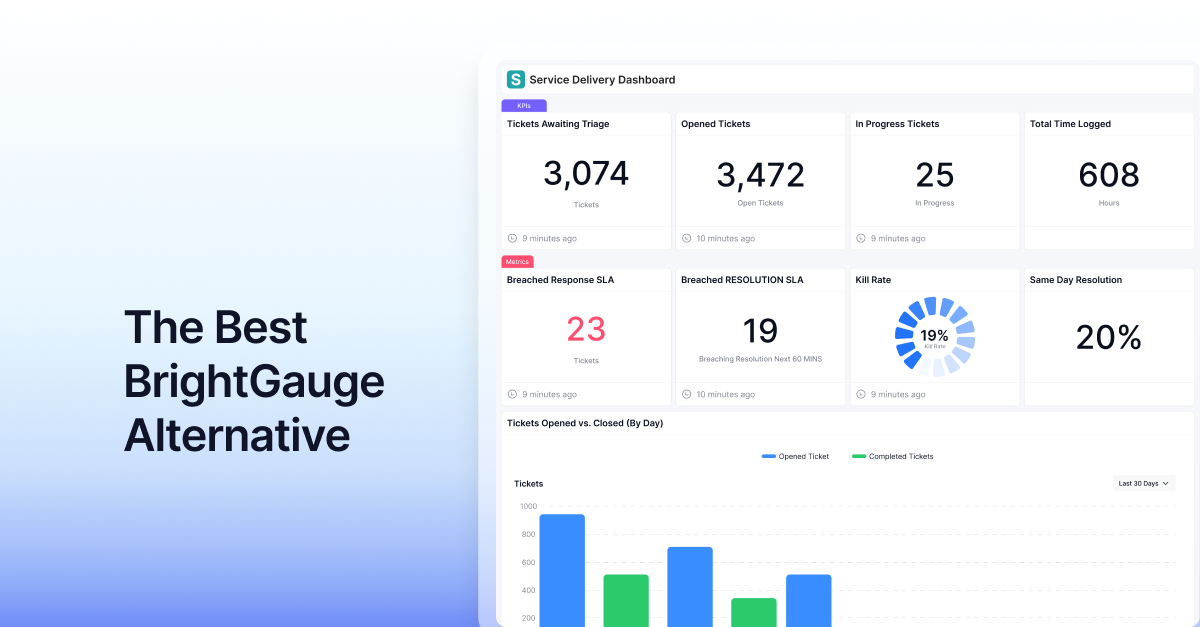

Tired of BrightGauge? You're not alone — and you don't have to start from scratch to leave it.
If you're reading this, chances are you've hit one of three walls: your historical data disappears after roughly 210 days; you're tired of a software that stopped updating, or you're stuck manually stitching PSA, RMM, and accounting data into a report that still doesn't tell you much more than a basic gauge would.
Here's the offer: MSPbots will transfer every one of your BrightGauge dashboards for you — free — and put you on MSPbots Business Intelligence for 120 days before you pay anything. That means 80+ native integrations instead of BrightGauge's roughly 50, 20+ widgets with AND/OR filtering instead of 10 basic gauges, up to 4 years of historical data instead of ~210 days, and bots that monitor your dashboards and trigger alerts automatically — something BrightGauge doesn't do at all. See it running on your own data before you decide it's worth paying for.
Here is a detailed comparison of MSPbots and BrightGauge. Book a demo and experience MSPbots Business Intelligence today!
Why MSPs Are Searching for a BrightGauge Alternative in 2026
Reporting expectations have moved faster than a lot of legacy dashboard tools have. The broader business intelligence market is on pace to approach $55 billion by 2026, growing at more than 12 percent a year according to recent industry analysis, and a lot of that growth is being driven by tools that make it easier, not harder, to combine data sources and act on what they show.
MSPs haven't fully caught up to that shift. Survey data suggests that nearly 87 percent of MSPs feel they aren't using their business intelligence tools as completely or effectively as they should, according to recent MSP industry research. That gap is often a tooling problem as much as a habit problem: if the platform caps how far back you can look, or makes it painful to pull ConnectWise, Autotask, or accounting data into a single service board view, technicians and owners stop trusting the numbers and drift back to gut feel.
That's the pattern behind most BrightGauge alternative searches. It's rarely about wanting to switch for its own sake. It's about three specific limitations that keep showing up once an MSP has been on the platform for a couple of years.
The Three Limitations MSPs Cite Most Often
Every platform has tradeoffs, and BrightGauge is no exception. Independent review sites back up what MSPs describe anecdotally: detailed reviews of the platform note that its data pulls come from its own datasets rather than directly from source databases, which limits both how current the data is and how far back it goes, and that its connector library stays narrowly focused on the MSP tools it originally launched with.
Historical Data Retention Limits
BrightGauge caps historical data retention well short of a full year, which makes year-over-year comparisons and multi-quarter trend charts difficult without exporting and stitching data together by hand. For a QBR that's supposed to show a client twelve months of ticket trends or an owner trying to benchmark technician utilization across a full fiscal year, that cap turns a two-minute dashboard pull into a spreadsheet project. MSPbots retains a full 365 days of history natively, so year-over-year views are available inside the dashboard without extra engineering.
Monthly Cost That's Hard to Scale Down
Most MSPs report BrightGauge running somewhere in the range of $400 to $500 a month once they're connected to their PSA and a couple of other sources, and reviewers note it's difficult to reduce that cost even when you need fewer data sources than you originally signed up for. MSPbots' Business Intelligence dashboards are priced to scale with what you actually connect, which is a meaningfully different cost curve for a 10 to 20 person MSP than a flat, hard-to-adjust monthly fee.
Difficulty Unifying Multiple Data Sources
The third complaint is the one that costs the most in hidden labor: getting PSA, RMM, accounting, and ticketing data into a single unified view. When a platform's integrations stay narrow, technicians end up toggling between three or four separate reports to answer one question, like whether a client's rising ticket volume is actually eating into that contract's profitability. MSPbots was built around combining these sources natively, so a single dashboard can pull PSA ticket data alongside financials without a manual export step in between.
What Makes MSPbots a Strong BrightGauge Alternative
Beyond fixing those three specific gaps, MSPbots approaches reporting as one part of a broader operating system rather than a standalone dashboard tool. Here's how the two platforms compare on the factors MSPs weigh most heavily:
.png)
That last row matters more than it looks. Assessing whether a reporting platform actually fits your operation takes time, and a 30-day window rarely covers a full onboarding and first reporting cycle. MSPbots also layers in ticket-level intelligence that BrightGauge doesn't attempt, including NextTicket dispatch automation and quality review through AI Ticket QA, so the same data feeding your dashboards is also driving day-to-day service delivery decisions.
What Should MSPs Look for in a BrightGauge Alternative?
Start with data retention and integration breadth before comparing sticker price. A cheaper tool that can't hold a year of history or connect to your accounting platform will cost you more in manual workarounds than the subscription ever saved. Ask any vendor you're evaluating exactly how long they retain historical data, and get specific about which of your current tools (PSA, RMM, accounting, ticketing) connect natively versus requiring a custom build.
Next, look at who has to build and maintain your dashboards. Some platforms require a dedicated analyst or a paid services engagement every time you want a new report. Others, including MSPbots, are designed so operations leads can build and adjust dashboards themselves, with prebuilt templates covering the metrics most MSPs track on day one: technician utilization, agreement profitability, SLA compliance, and ticket aging.
Finally, factor in total cost of ownership, not just the monthly invoice. A $300 a month tool that takes eight hours of admin time to keep current is more expensive than a $400 a month tool that doesn't. Ask vendors for a realistic estimate of ongoing maintenance time before you sign, and if possible, ask for a trial period long enough to actually test that claim against your own data.
How Does BrightGauge Pricing Compare to MSPbots in 2026?
BrightGauge pricing for a typical PSA-connected setup runs roughly $400 to $500 a month, and that figure tends to climb as MSPs add data sources. Reviewers have specifically flagged that scaling the plan back down when fewer sources are needed isn't straightforward, which means the cost curve tends to move in one direction only. For an MSP with 15 to 25 technicians, that adds up to a meaningful annual expense for a tool that's capped at roughly 210 days of historical data.
MSPbots takes a different approach to pricing, scaling based on the data sources and modules an MSP actually connects rather than a flat, hard-to-adjust fee. Because dashboards, automation, and ticket intelligence live on the same platform, MSPs often consolidate what used to be two or three separate subscriptions (a reporting tool, a separate automation tool, and manual QA processes) into one. The clearest way to see the real number for your environment is to book a demo and get a quote based on your actual PSA and data source count rather than a generic published rate.
How Expedient Technology Solutions Replaced BrightGauge
Expedient Technology Solutions, a cybersecurity-focused MSP based in the Dayton and Cincinnati area, ran into a familiar problem with BrightGauge: the platform could show data, but confirming that the data was actually right took far too long to be useful in the moment.
"We think we're doing this. We think we're doing that," said Jeff Lehman, describing life on BrightGauge before the switch. "But all those things we wanted to verify took a long time to confirm."
After moving to MSPbots, Expedient ended up with 150 live dashboards and 1,150 widgets covering their operation, along with same-day turnaround on custom reports whenever a new question came up. That last detail is the practical difference between a reporting tool you check occasionally and one you actually run the business on: when a custom report can be built and delivered the same day, teams stop working around the dashboard and start working from it.
Expedient's experience is a useful benchmark for any MSP sizing up its own move. MSPbots will transfer your BrightGauge dashboards for free and give you 120 days to run MSPbots Business Intelligence before you pay anything. Start your free transfer to see what your own PSA data looks like on the same platform that got Expedient to 150 live dashboards and 1,150 widgets.
January 28, 2024